
Projects

Sustainability and Performance Assessment of Pavement Preservation Strategies in the Southwest Region
🤝Sponsor: Southwest Pavement Technology
📅 2025 – Ongoing
Pavement preservation applies targeted treatments at the right time to slow deterioration and extend road life. However, choosing the right treatment for the right pavement at the right time can be challenging. This decision depends on several factors, including pavement condition, traffic volume, climate, budget, and environmental impact. This project develops a practical framework to help Arizona agencies optimize preservation strategies across their networks.

Assessment of Pavement Mechanistic-Empirical Design Software
🤝Sponsor: ADOT
📅 2025 – Ongoing
ADOT is interested in evaluating pre- and post-project pavement performance data for ADOT pavement designs. This study would examine recent and new ADOT construction projects and rehabilitation projects to verify the reliability, suitability, and acceptability of the results and recommendations provided by AASHTOWare Pavement ME Design 3.0 software for the performance of rigid and flexible pavements on Arizona’s roads.
The objective of this study is to evaluate the predictive performance of PaveME relative to actual pavement performance on past pavement rehabilitation projects.

Design Model for Reflection Cracking in Airport Asphalt Overlays (Phase II)
🤝Sponsor: Federal Aviation Administration (FAA)
📅 2025 – Ongoing
This project builds upon Phase I of the developed mechanistic framework for AC overlay design on jointed rigid pavement structures.
Phase II responds to the FAA’s long-range goal of translating that simulation capability into a practical design tool by developing transfer functions that connect mechanistic crack-propagation calculations to observable field outcomes.
The ultimate objective is validated transfer functions that can be implemented in FAARFIELD, the FAA’s pavement design software used at airports nationwide.

Assessing the Consumption Costs of Motor Vehicles on Arizona Roads and Bridges
🤝Sponsor: ADOT
📅 2024 – Ongoing
The Arizona Department of Transportation (ADOT) is responsible for building, operating, and maintaining the state highway system’s roads and bridges; the primary source of funding is fuel taxes. What are the impacts of heavier and over-dimension/overweight (OD-OW) vehicles on Arizona’s transportation infrastructure compared to other vehicle classes? This research study will identify and document the current impact on Arizona’s roads and bridges by motor vehicles classified in the following three categories: passenger vehicles, commercial vehicles, and OD-OW vehicles. The study will determine the consumption costs (i.e., the costs to build, maintain, and repair the roads and bridges) for each vehicle category.
Assessment of Asphalt Shear Rutting Test Method to Improve the Performance of ADOT Asphalt Mixes
🤝Sponsor: ADOT
📅 2024 – Ongoing
The Arizona Department of Transportation (ADOT) is currently engaged in a research project to assess innovative test methods for predicting the cracking resistance of ADOT asphalt mixes across the state. The ADOT Materials Laboratory (Lab) obtained an apparatus known as the IDEAL-RT, which is used to conduct the shear rutting tests that predict the resistance to rutting (permanent deformation) of asphalt mixes. The Lab is interested in this test method to determine if it is acceptable for regular use in future rutting-resistance assessments of ADOT asphalt mixes. To refine its mix designs and improve resistance to cracking and rutting, the Lab needs valid, reliable methods to test and predict asphalt performance. This project will focus on assessing the IDEAL-RT as a tool for predicting rutting resistance.

Assessment of Thermal and Durability Cracks in Asphalt Pavements in the Southwest Region
🤝Sponsor: Southwest Pavement Technology
📅 2023 – Ongoing
Durability cracking in asphalt pavements is a major deterioration mechanism in asphalt concrete (AC) pavements in areas experiencing extreme temperatures and precipitation. In this study, we develop a case study example of thermal and durability cracks widely observed in the Southwest of the United States. Significant factors and root causes influencing the occurrence of thermal durability cracks are presented using data compiled from forensic investigations of sites, field core characterization, and mechanistic assessment of conventional flexible pavement structures.

Development of Asphalt Concrete Mixture Long-Term Aging Protocol for Arizona’s Climatic Conditions
🤝Sponsor: Southwest Pavement Technology
📅 2023 – Ongoing
Field aging of asphalt concrete (AC) mixtures is a complex phenomenon that results in significant changes in the rheological properties and chemistry of binders, thereby impacting key performance characteristics of asphalt mixtures. Laboratory simulation of the field aging characteristics of asphalt concrete (AC) mixes is essential in characterizing their long-term performance. Hence, long-term aging protocols have become a key part of the Balanced Mix Design (BMD) framework adopted by many state and local agencies.

Fracture Characterization of Polymer-Modified Mixes for Applications in Diverse Climatic Regions
🤝Sponsor: Southwest Pavement Technology
📅 2021 – 2022
Although cracking resistance research has been carried out extensively in other states, a large amount of the work is not immediately applicable to Arizona, where the climate is substantially more extreme both in heat and in cold than many other parts of the country.
The main goal is to develop a balanced mix design framework that can be used across diverse climatic regions and to better understand the fracture behavior of polymer-modified mixes.
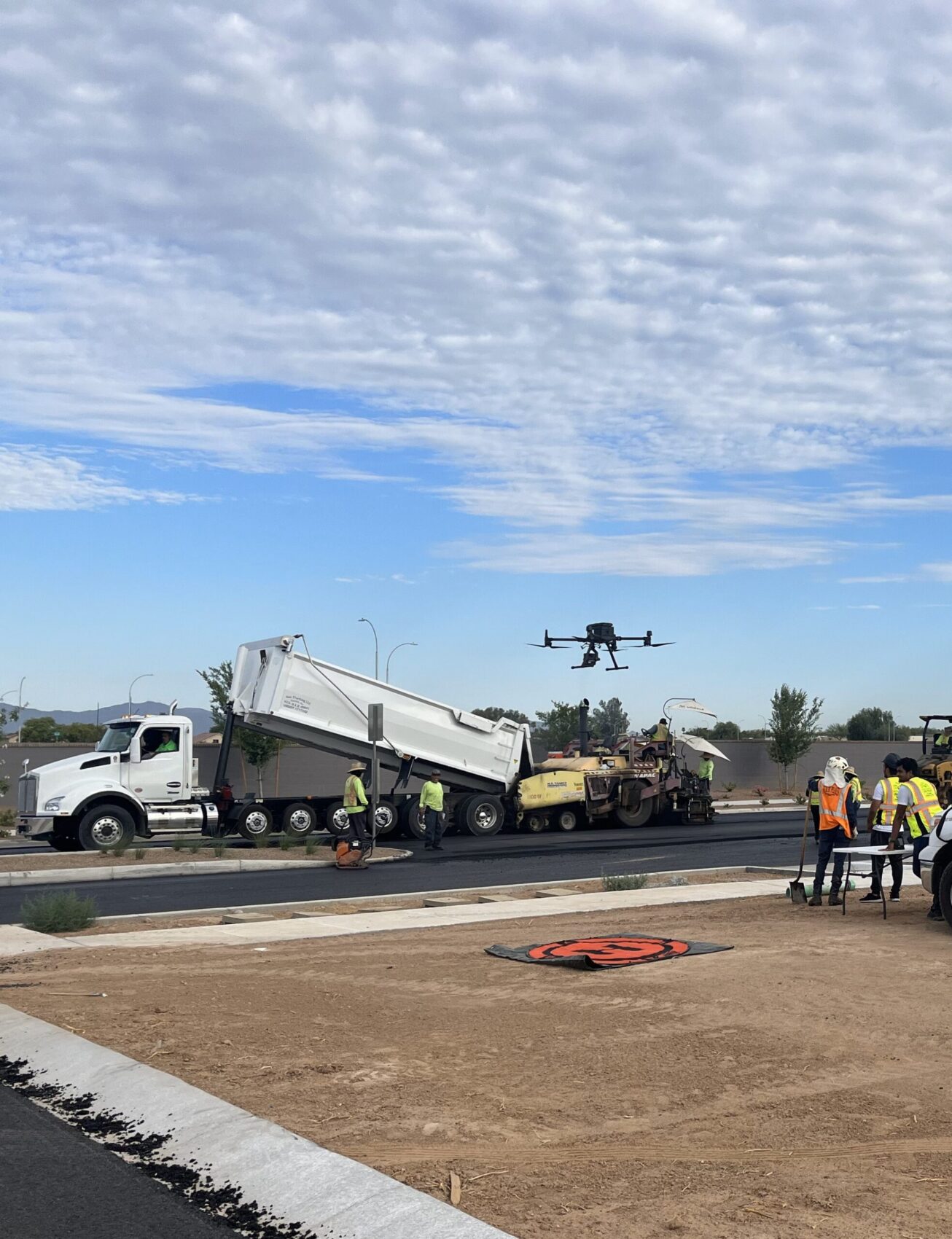
Construction Quality Monitoring of Hot Mix Asphalt Using UAV Thermal Imagery
🤝Sponsor: National Center for Infrastructure Transformation (NCIT)
📅 2022 – Ongoing
Proper compaction during asphalt paving is one of the most consequential decisions in pavement construction. Empirical evidence suggests that even a one percent increase in in-place density translates to at least 10 percent longer service life. Yet monitoring compaction across hundreds of feet of rapidly cooling mat is difficult, and areas that cool too quickly before reaching target density leave behind hidden zones of reduced performance that surface as early distress years later. Existing technologies have limitations. For instance, paver-mounted thermal profilers capture only the narrow strip behind the screed, while Intelligent Compaction systems require expensive instrumented rollers and show inconsistent correlations. This project developed an alternative, a UAV equipped with an infrared thermal camera flying above the paving operation, transmitting thermal maps of the entire placed mat.

Advancing Knowledge in Cracking Resistance of Fiber-reinforced Asphalt Concrete (FRAC)
🤝Sponsor: FORTA Corporation
📅 2020 – 2024
Fiber reinforcement is considered to improve the cracking resistance of asphalt concrete (AC). Fibers can delay crack propagation and improve fracture resistance through various mechanisms of crack bridging.
The main goal of this study is to investigate the cracking performance of Fiber Reinforced Asphalt Concrete (FRAC) based on comprehensive fracture characterization performed through a series of monotonic and fatigue fracture-type experiments.
Reflective Cracking Model for Airport Asphalt Overlay Design (Phase I)
🤝Sponsor: Federal Aviation Administration (FAA)
📅 2021 – 2024
When asphalt overlays are placed over jointed concrete airport pavements, reflective cracking is nearly inevitable. Concrete slabs expand and contract with temperature, propagating cracks upward through the overlay while heavy aircraft gear loads create stress concentrations at the crack tip in all three fracture modes simultaneously. Left unchecked, reflective cracks allow water infiltration, weaken the pavement structure, and dramatically shorten overlay service life. This project develops fracture mechanics-based computational models to predict reflective cracking in asphalt overlays on jointed concrete airport pavements, accounting for both thermal loading from slab movement and aircraft traffic loading across diverse climatic conditions.

Evaluation of Antistripping Additives for Arizona Asphalt Mixes
🤝Sponsor: Southwest Pavement Technology
📅 2021 – 2022
Moisture is one of asphalt pavement’s most persistent enemies. When water infiltrates the bond between asphalt binder and aggregate, pavements weaken from the inside out, a process accelerated by Arizona’s extreme heat and monsoon conditions. This study evaluates the performance of liquid antistripping agents (LAS) against mineral admixtures under Arizona-specific conditions, providing agencies with data-driven guidance on cost-effective solutions for moisture-induced pavement damage

Impact of Automated and Connected Trucks (Platoons) on Pavement Deterioration Mechanisms
🤝Sponsor: CCAT, ICT
📅 2020 – 2023
Automation technology offers numerous advantages to the trucking industry, including fuel savings, operational efficiencies, and the prevention of fatal crashes. Truck spacing is one of the key parameters of a truck platoon that can be optimized to balance fuel savings and pavement impact. The rest period, defining the duration between the loading applications from two consecutive trucks, can impact permanent deformations and fatigue cracking in asphalt pavements.
The main challenge with this new loading scenario is the uncertainty in the stress state configurations that may be generated during the platoon’s loading phase.