
Reflective Cracking Model for Airport Asphalt Overlay Design (Phase I)
📨 Principal Investigator: Hasan Ozer
🔖 Co-PI: Imad L. Al-Qadi, Carlos Armando Duarte
🤝 Sponsor: Federal Aviation Administration (FAA)
📅 Timeline: 2021 – 2024
Highlights
Introduction
When an asphalt concrete overlay is placed on top of an existing jointed concrete pavement at an airport, one of the most predictable distresses that follows is reflective cracking. The concrete slabs below expand and contract with daily and seasonal temperature changes, which propagates the crack upward through the overlay. Aircraft traffic adds another layer of complexity: heavy gear loads passing over the joints create stress concentrations at the crack tip in all three fracture modes simultaneously. Left unchecked, reflective cracks allow water to infiltrate, weaken the pavement structure, and dramatically reduce the overlay’s service life.
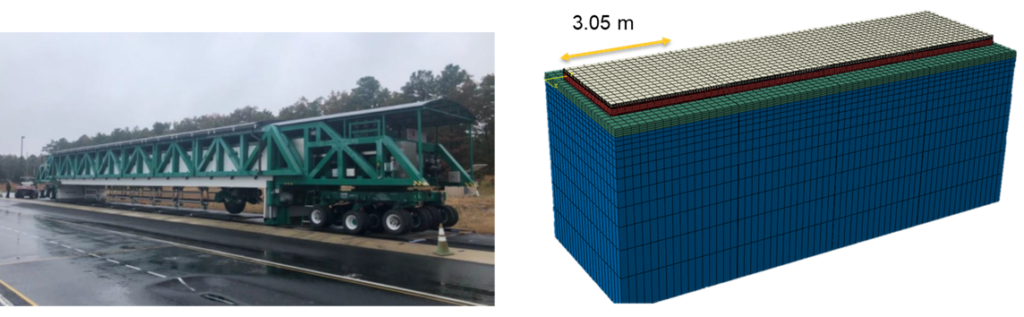
Despite its importance, reflective cracking has historically been absent from the Federal Aviation Administration’s (FAA) primary pavement design tool, FAARFIELD. The FAA’s Reflective Cracking Study Program, initiated in the early 2010s through full-scale indoor and outdoor testing at the William J. Hughes Technical Center, built an invaluable experimental foundation.
The objective of this project is to developed fracture mechanics-based computational models to predict reflective cracking in asphalt concrete overlays on jointed concrete airport pavements, accounting for both thermal loading from PCC joint movement and aircraft traffic loading under diverse climatic conditions.
Methodology and Framework
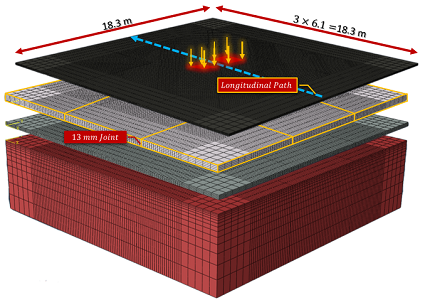
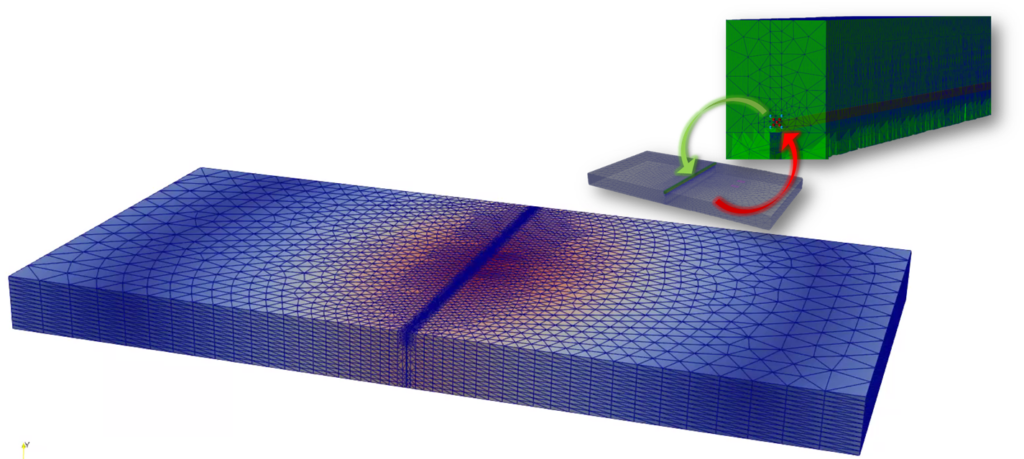
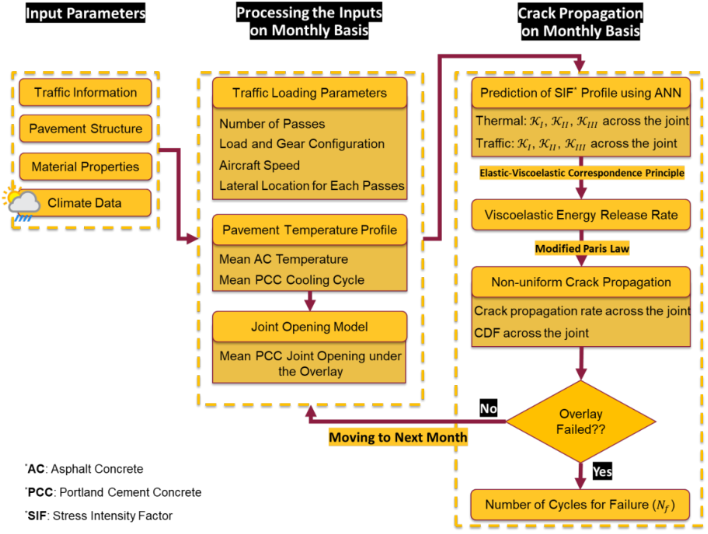
The computational framework developed in this study has three integrated components. The first is a pavement temperature prediction model that calculates the hourly temperature profile through the pavement cross-section and the corresponding PCC joint opening. The second is a suite of 3-D fracture simulations using the Generalized Finite Element Method (GFEM) to calculate stress intensity factors (SIF) across all three fracture modes (Mode-I opening, Mode-II sliding, Mode-III tearing) as a function of crack length, joint opening, overlay thickness, and material properties. The third is an Artificial Neural Network (ANN) surrogate model trained on thousands of GFEM simulations, enabling fast SIF prediction for arbitrary input combinations without the full computational cost of 3-D fracture simulations.
The Elastic-Viscoelastic Correspondence Principle (EVCP) bridges the gap between the elastic GFEM solutions and the time- and temperature-dependent behavior of asphalt concrete. By applying EVCP, the elastic SIF values are converted to viscoelastic energy release rates (ERR), properly accounting for the fact that asphalt behaves as a viscoelastic material whose response depends on both temperature and loading rate. Crack growth is then predicted using a modified Paris Law, where the cumulative crack propagation per cycle is a function of the viscoelastic ERR. Aircraft wander is modeled using a normal distribution consistent with FAA’s existing design methods, and non-uniform crack propagation across the joint width is captured explicitly in 3-D.
Key Findings
Dominance of Mode-II Fracture Under Traffic

A fundamental insight from the 3-D fracture simulations was that Mode-II (in-plane shear) is the dominant fracture mode for reflective cracking under aircraft traffic loading. When an aircraft wheel passes over a joint, the relative horizontal displacement between the two slab edges creates a shearing stress at the crack tip that dominates over the crack-opening (Mode-I) component, except in the specific case where the load is centered exactly over the joint and at the center of the slab. In all other lateral load positions along the joint, Mode-II controls crack propagation.
Traffic loading was also found to be the primary driver of overall crack propagation rate when both thermal and traffic effects were considered simultaneously. In some of the case studies, the combined case showed that thermal loading contributed approximately 20% of the total crack propagation rate, with the remaining 80% driven by traffic
ANN-Based Efficient Design Algorithm
A practical innovation of this study was the development of ANN models by UIUC that can predict SIF profiles across the crack front for any combination of structural inputs and loading conditions. The ANN models were trained on a database of GFEM simulations covering a wide range of overlay thicknesses, pavement layer moduli, crack lengths, joint openings, and load positions.
The resulting surrogate models predict Mode-I, Mode-II, and Mode-III SIF values with high accuracy, reducing computation time from hours to seconds per design case, where design computations must run interactively on standard engineering workstations.