Advancing Knowledge in Cracking Resistance of Fiber-reinforced Asphalt Concrete (FRAC)
📨 Contact: Hasan Ozer ([email protected]) and Kamil Kaloush ([email protected])
🤝 Sponsor: FORTA Corporation
📅 Timeline: Aug 2020 – Continued
Identifying the Challenges of FRAC
Fiber reinforcement is considered to improve the cracking resistance of asphalt concrete (AC). Fibers can delay the crack propagation and improve fracture resistance through various crack-bridging mechanisms. While the production of fiber-reinforced concrete (FRC) involves high-fiber dosage, the dosage in AC needs to be optimized to avoid workability-related issues. Therefore, the fiber application in AC is typically kept at low dosages. Although low-dosage reinforcement is low-cost and has minimal or no effect on the AC mix design’s volumetric properties, its efficacy in improving AC cracking resistance needs to be investigated.
The main goal of this study is to investigate the cracking performance of Fiber Reinforced Asphalt Concrete (FRAC) based on comprehensive fracture characterization performed through a series of monotonic and fatigue fracture-type experiments. The outcome of this study will be used to understand the effect of types of fiber, fiber dosage, fiber delivery methods, mix gradations, testing temperature, and loading rate in FRAC cracking performance. Finally, a performance- based design guideline for producing FRAC is to be established.
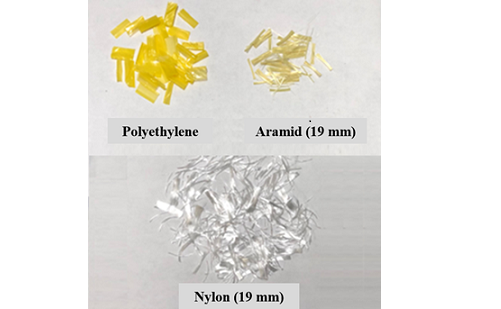
Figure 1: Types of fiber investigated
Experimental Methods for Plant and Laboratory-Produced Mixes
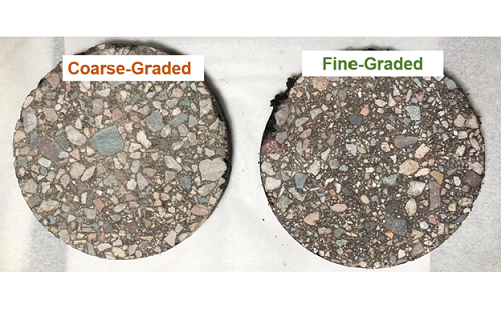
Figure 2: Types of dense-graded mix
For this study, two synthetic fiber types were used which include a blend of polyethylene (PE) and aramid, and nylon (Fig. 1). Two different mix designs were developed using the same aggregate sources which includes a coarse- and a fine-graded mixture using Bailey method to understand effect of gradation on FRAC performance (Fig. 2). Several plant produced mixes were also collected for testing purposes.
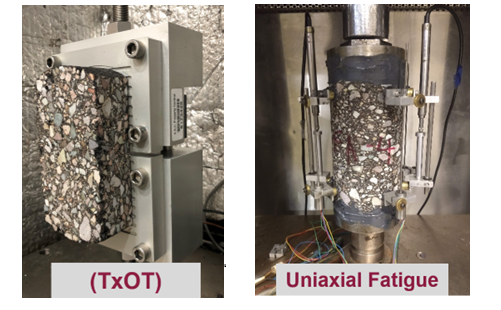
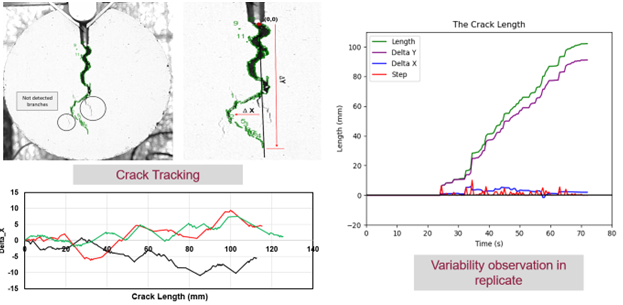
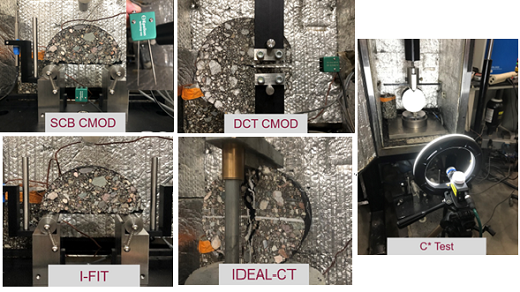
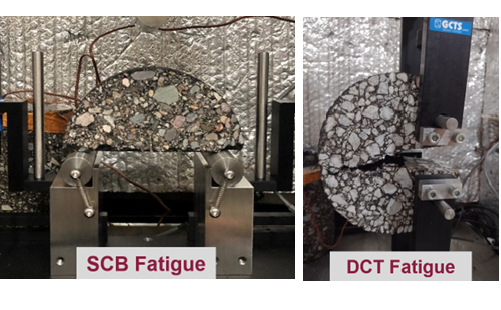
The study covers a range of monotonic and fatigue-type experiments to evaluate FRAC performance. The monotonic experiments include two crack mouth opening displacement (CMOD)-control tests: semi-circular bending (SCB) and disk-compact tension (DCT), and two load-line displacement (LLD)-control index-based tests: Illinois Flexibility Index Test (I-FIT) and Indirect Tensile Asphalt Cracking Test (IDEAL-CT). The fatigue experiments include Texas Overlay Test (TxOT), SCB-Fatigue test, DCT-Fatigue test, and Uniaxial Fatigue test (Fig 3). In addition, a multi-rate-dependent monotonic fracture experiment named C* is also under development to include a laser-based non-contact mode of CMOD-control where crack progression is tracked using the industry-leading state-of-the-art vision camera system (Fig 4). Other fracture experiments under development include a cyclic-SCB experiment and a novel fiber pullout test protocol.
A Comprehensive Approach to understanding FRAC performance
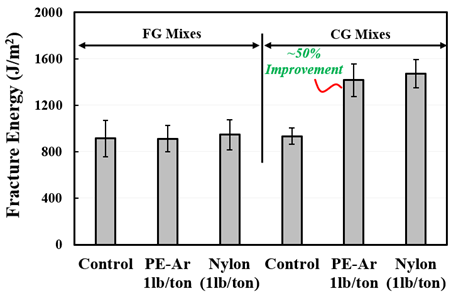
The ongoing investigation explores the monotonic and fatigue fracture performance of FRAC and observes any bias based on mix gradation, fiber type, test condition, and test configurations. It is observed that with select mix gradations and test conditions, more than 50% improvement in fracture energy of FRAC can be achieved (Fig 5). Investigation on plant-produced mixes is underway to confirm the observed trend.