
AI and MBE Automation
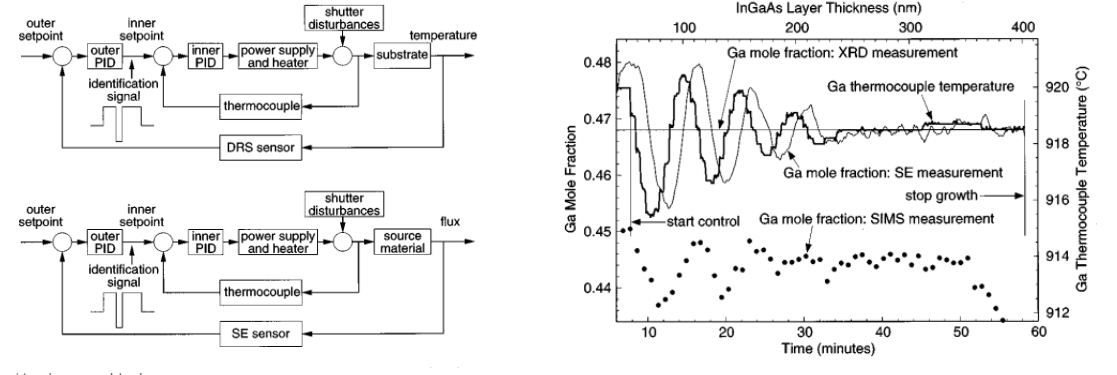
We demonstrated a closed-loop real-time-control of MBE growth using feed-back from an in-situ spectroscopic ellipsometer (SE) and a large material data base, which enabled precise control of layer thickness and alloy composition within one run without the need of ex situ characterization. The dynamic optical constant (OC) database developed for composition control of InGaAs and InAlAs alloys within a large growth temperature range has been accurately parameterized to improve the stability during real-time control. Additionally, we invented several new methods for RHEED with rotating substrates, which significantly enhanced the in-situ real-time characterization capabilities for MBE and other epitaxial growth methods using rotating substrates, which have promoted the progress of MBE automation and provided a tool for AI-controlled thin-film growth.
M. Beaudoin, E. Grassi, S. R. Johnson, K. Ramaswamy, K. Tsakalis, T. L. Alford, Y.-H. Zhang; Real-time composition control of InAlAs grown on InP using spectroscopic ellipsometry. J. Vac. Sci. Technol. B 1 May 2000; 18 (3): 1435–1438. https://doi.org/10.1116/1.591398
M Beaudoin, P Kelkar, M.D Boonzaayer, W Braun, P Dowd, S.R Johnson, U Koelle, C.-M Ryu, Y.-H Zhang, Growth of resonant-cavity enhanced photodetectors by MBE with in situ feedback control using spectroscopic ellipsometry, Journal of Crystal Growth, Volumes 201–202, 1999, Pages 990-993, ISSN 0022-0248, https://doi.org/10.1016/S0022-0248(98)01511-5.
M. Beaudoin, S. R. Johnson, M. D. Boonzaayer, Y.-H. Zhang, B. Johs; Use of spectroscopic ellipsometry for feedback control during the growth of thin AlAs layers. J. Vac. Sci. Technol. B 1 May 1999; 17 (3): 1233–1236. https://doi.org/10.1116/1.590728
W. Braun, H. Möller, Y.-H. Zhang; Accurate growth rate determination on rotating substrates using electron diffraction dynamics. Appl. Phys. Lett. 4 January 1999; 74 (1): 138–140. https://doi.org/10.1063/1.122975
W Braun, H Möller, Y.-H Zhang, Phase-locked substrate rotation: new applications for RHEED in MBE growth, Journal of Crystal Growth, Volumes 201–202, 1999, Pages 50-55, ISSN 0022-0248, https://doi.org/10.1016/S0022-0248(98)01277-9.
W. Braun, H. Möller, S. R. Johnson, Y.-H. Zhang; Reflection high-energy electron diffraction oscillations on rotating substrates. J. Vac. Sci. Technol. B 1 March 1999; 17 (2): 474–476. https://doi.org/10.1116/1.590579
Shane Johnson, Chau-Hong Kuo, Martin Boonzaayer, Wolfgang Braun, Ulrich Koelle, Yong-Hang Zhang, John Roth; In situ temperature control of molecular beam epitaxy growth using band-edge thermometry. J. Vac. Sci. Technol. B 1 May 1998; 16 (3): 1502–1506. https://doi.org/10.1116/1.589975
S. R. Johnson, E. Grassi, M. Beaudoin, M. D. Boonzaayer, K. S. Tsakalis, Y. H. Zhang; Closed-loop control of composition and temperature during the growth of InGaAs lattice matched to InP. J. Vac. Sci. Technol. B 1 May 1999; 17 (3): 1237–1240. https://doi.org/10.1116/1.59072
C.-H. Kuo, M. Boonzaayer, M. DeHerrera, T. Kyong, Y.-H. Zhang, B. Johs, J. S. Hale; Real time in situ composition control of InGaAs lattice matched to InP by an 88-wavelength ellipsometer. J. Vac. Sci. Technol. B 1 May 1998; 16 (3): 1484–1488. https://doi.org/10.1116/1.589971
W. Braun, H. Möller, Y.-H. Zhang; Reflection high-energy electron diffraction during substrate rotation: A new dimension for in situ characterization. J. Vac. Sci. Technol. B 1 May 1998; 16 (3): 1507–1510. https://doi.org/10.1116/1.589976
Type-II Super Lattice (T2SL) Infrared Materials and Detectors

Prof. Zhang demonstrated the first InAs/InAsSb type-II superlattice materials and lasers in the 90’s. The follow-on work at ASU demonstrated long carrier lifetime and first detector using the InAs/InAsSb T2SL nBn IR detectors. The work inspired a worldwide research and development efforts, which have resulted in novel IR photodetector used in actually applications.
Zhang, Y.-H., “Continuous wave operation of InAs/InAsxSb1−x midinfrared lasers”, Appl. Phys. Lett. 66, 118-120. (1995)
Steenbergen, E. H., Connelly, B. C., Metcalfe, G. D., Shen, H., Wraback, M., Lubyshev, D., Qiu, Y., Fastenau, J. M., Liu, A. W. K., Elhamri, S., Cellek, O. O., & Zhang, Y.-H., “Significantly improved minority carrier lifetime observed in a long-wavelength infrared III-V type-II superlattice comprised of InAs/InAsxSb1-x”, Appl. Phys. Lett. 99, 251110. (2011)
Kim, H. S., Cellek, O. O., Lin, Z.-Y., He, Z.-Y., Zhao, X.-H., Liu, S., Li, H., & Zhang, Y.-H., “Long-wave infrared nBn photodetectors based on InAs/InAsxSb1-x type-II superlattices”, Appl. Phys. Lett. 101, 161114. (2012).
Prins, A. D., Lewis, M. K., Bushell, Z. L., Sweeney, S. J., Liu, S., and Zhang, Y.-H., “Evidence for a defect level above the conduction band edge of InAs/InAsxSb1-x type-II superlattices for applications in efficient infrared photodetectors”, Appl. Phys. Lett. 106, 171111. (2015)
Tsai, C.-Y., Zhang, Y., Ju, Z., and Zhang, Y.-H., “Study of vertical hole transport in InAs/InAsxSb1-x type-II superlattices by steady-state and time-resolved photoluminescence spectroscopy”, Appl. Phys. Lett. 116, 201108. (2020)
Solar Cells

We demonstrated monocrystalline CdTe/MgCdTe double-heterostructure solar cells with a record VOC over 1.1 V and efficiency ~20%, and 1.7 eV MgCdTe solar cells for a tandem cell integrated with Si. We also demonstrated ultra-thin (0.3 µm) GaAs single-junction solar cells integrated with a reflective back scattering layer and developed a water-based epitaxial lift-off (ELO) technique for thin-film CdTe solar cell fabrication. Additionally, we explained the origin of artifacts in EQE measurements of multijunction solar cells and proposed novel methods to correct that.
Jia Ding, Calli M. Campbell, Jacob J. Becker, Cheng-Ying Tsai, Stephen T. Schaefer, Tyler T. McCarthy, Mathieu Boccard, Zachary C. Holman, and Yong-Hang Zhang. Monocrystalline 1.7-eV MgCdTe solar cells. Journal of Applied Physics 131, 023107 (2022).
Jia Ding, Cheng-Ying Tsai, Zheng Ju, and Yong-Hang Zhang. Epitaxial lift-off CdTe/MgCdTe double heterostructures for thin-film and flexible solar cells applications. Applied Physics Letters 118, 181101 (2021).
Jacob J. Becker, Mathieu Boccard, Calli M. Campbell, Yuan Zhao, Maxwell Lassise, Zachary C. Holman, and Yong-Hang Zhang. Loss analysis of monocrystalline CdTe solar cells with 20% active-area efficiency. IEEE Journal of Photovoltaics 7, 900–905 (2017).
Yuan Zhao, Mathieu Boccard, Shi Liu, Jacob Becker, Xin-Hao Zhao, Calli M. Campbell, Ernesto Suarez, Maxwell B. Lassise, Zachary Holman, and Yong-Hang Zhang. Monocrystalline CdTe solar cells with open-circuit voltage over 1 V and efficiency of 17%. Nature Energy 1, 16067 (2016).
Weiquan Yang, Jacob Becker, Shi Liu, Ying-Shen Kuo, Jing-Jing Li, Barbara Landini, Ken Campman, and Yong-Hang Zhang. Ultra-thin GaAs single-junction solar cells integrated with a reflective back scattering layer. Journal of Applied Physics 115, 203105 (2014).
Swee Hoe Lim, Jing‐Jing Li, Elizabeth H. Steenbergen, and Yong‐Hang Zhang. Luminescence coupling effects on multijunction solar cell external quantum efficiency measurement. Progress in Photovoltaics: Research and Applications 21, 344–350 (2013).
Hetervalent MBE

Our group have demonstrated monolithic integration of various heterovalent semiconductors, such as II-VI on III-V, IV-IV on II-VI on III-V, IV-VI on II-VI, and vis versa. These integrations enabled excellent materials quality and device performance, such as record Voc for CdTe solar cells, high quality CdTe(211)-virtual substrates for HgCdTe IR detectors, and α-Sn(Ge) on CdTe for quantum transport study. Heterovalent DBRs using GaSb/ZnTe and GaAs/ZnSe have also demonstrated high reflectivity using fewer layers.
McCarthy, T.T., Ju, Z., Kodama, R., McMinn, A.M., Qi, X., Aqariden, F., Liao, P.-K., Mitra, P., & Zhang, Y.-H., “CdTe(211) virtual substrates grown on InSb(211)B for HgCdTe IR detectors”, Appl. Phys. Lett. (under review)
Basnet, R., Upreti, D., McCarthy, T.T., Ju, Z., McMinn, A.M., Sharma, M.M, Zhang, Y.-H., & Hu, J., “Magneto-transport study on Sn-rich Sn1-xGex thin films enabled by CdTe buffer layer”, J. Vac. Sci. Technol. B 42, 042210. (2024)
Zhang, Y.-H., and Smith, D.J. “Heterovalent semiconductor structures and devices grown by molecular beam epitaxy”, J. Vac. Sci. Technol. A 39, 030803. (2021)
Ding, J., Tsai, C.-Y., Ju., Z, & Zhang, Y.-H., “Epitaxial lift-off CdTe/MgCdTe double heterostructures for thin-film and flexible solar cell applications”, Appl. Phys. Lett. 118, 181101. (2021)
Lassise, M.B., McCarthy, T.T., Tracy, B.D., McMinn, Smith, D.J., & Zhang, Y.-H., “Molecular beam epitaxial growth and structural properties of hetero-crystalline and heterovalent PbTe/CdTe/InSb structures”, J. Appl. Phys. 126, 045708. (2019)
Zhao, Y., Boccard, M., Liu, S., Becker, J., Zhao, X.-H., Campbell, C.M., Suarez, E., Lassise, M.B. Holman, Z., & Zhang, Y.-H., “Monocrystalline CdTe solar cells with open-circuit voltage over 1 V and efficiency of 17%”, Nature Energy 1, 16067. (2016)
DiNezza, M.J., Zhao, X.-H., Liu, S., Kirk, A.P., & Zhang, Y.-H., “Growth, steady-state, and time-resolved photoluminescence study of CdTe/MgCdTe double heterostructures on InSb substrates using molecular beam epitaxy”, Appl. Phys. Lett. 103, 193901. (2013)